We are seeking a full-time Senior HPC Systems Administrator to join the Department of Engineering Science at the University of Oxford, working within the newly established The British Open-ended Learning and Discovery (BOLD) Lab, a major new UK Research and Innovation (UKRI) funded initiative that will establish a world-leading AI research laboratory at the University of Oxford. This is an exciting opportunity for an experienced systems professional to lead the development, administration, and strategic evolution of the labs high-performance computing (HPC) infrastructure supporting cutting-edge fundamental AI research, with three initial research pillars: Beyond backpropagation, human centric AI learning and discovery, and embodied learning. The successful candidate will take a leading role in the design, deployment, maintenance, and optimisation of large-scale HPC systems, including CPU and GPU clusters, high-performance storage, and advanced networking technologies. The postholder will work closely with academic researchers, software engineers, industry partners, and departmental IT teams to ensure robust, scalable, and secure computational infrastructure capable of supporting world-leading research in machine learning and visual computing. You will possess extensive experience in Linux systems administration and HPC environments, together with strong technical expertise in cluster management, storage systems, networking, scripting, and infrastructure automation. Experience with GPU computing environments, containerisation technologies, cloud platforms, and scientific software environments will be highly desirable. The role also requires excellent communication skills and the ability to collaborate effectively with both technical and non-technical stakeholders. The role includes responsibility for: ● Designing, building, and maintaining HPC clusters and associated infrastructure ● Managing Linux compute and storage environments ● Supporting GPU-enabled research computing systems ● Maintaining high-performance storage and backup solutions ● Monitoring system performance, security, and availability ● Supporting and mentoring researchers, software engineers, and postgraduate students ● Developing documentation, training materials, and operational best practices ● Collaborating with departmental and university-wide research IT teams ● Evaluating and deploying new technologies to support evolving research requirements The successful candidate will work under the direction of the departmental HPC Infrastructure Architect, with approximately 20% of their time allocated to broader departmental infrastructure activities. Essential Skills and Experience ● Degree in Computer Science, Engineering, or a related technical discipline ● Extensive experience managing HPC infrastructure in research or technical environments ● Strong Linux systems administration expertise ● Experience with GPU servers and high-performance networking technologies ● Experience with scripting and automation (e.g. Bash, Python) ● Knowledge of storage systems and backup/archive procedures ● Strong troubleshooting and systems integration skills ● Excellent written and verbal communication abilities ● Ability to work independently and collaboratively in a research environment Desirable Skills ● Experience with SLURM or other job scheduling systems ● Experience with containerisation and virtualisation technologies ● Knowledge of cloud computing platforms ● Familiarity with scientific computing tools and AI/ML research workflows ● Experience supporting research software or academic computing environments ● Knowledge of high-performance file systems such as BeeGFS or Lustre For informal enquiries, please contact: [email protected] For more information about working at the Department, see: www.eng.ox.ac.uk/about/work-with-us/ Only online applications received before midday on the closing date can be considered. You will be required to upload: ● A covering letter/supporting statement explaining how your skills and experience meet the selection criteria ● A CV ● Details of two referees The Department holds an Athena Swan Bronze Award, recognising its commitment to advancing gender equality and supporting an inclusive working environment.
Job listings
Visa sponsorship jobs in Oxford
Jobs at employers on the Home Office register of licensed sponsors. Confirm sponsorship with the employer for each role.
2 jobs
If you’re a software engineer who enjoys building high-quality applications, has an interest in biology and experience working with biological data, and wants to work on tools that enable scientists to explore complex data and generate meaningful insights, this is your opportunity to join OBT as a Scientific Software Engineer. We look forward to hearing from you! About Oxford Biotherapeutics (OBT) Oxford Biotherapeutics (OBT) is a clinical‑stage biotechnology company developing innovative antibody‑based therapeutics for the treatment of cancer. You will contribute directly to the pre‑clinical development of our immuno‑oncology pipeline. Our proprietary OGAP® platform, the world’s largest cancer‑specific membrane protein library enables the discovery of novel, highly tumour‑specific antigens for first‑in‑class ADC, Bispecific T‑cell Engager (BITE®), and CAR‑based therapeutics. Our lead asset, OBT076, is in Phase 1b clinical development, supported by a strong internal and partnered pipeline with leaders such as Roche, GSK, Bristol Myers Squibb, Boehringer Ingelheim, and Zymeworks. Learn more at www.oxfordbiotherapeutics.com. Introduction to the role We are seeking a Scientific Software Engineer to design, build, and evolve applications and systems for scientific data interrogation and analysis, with a strong focus on biological and bioinformatics data workflows. This role sits at the intersection of software engineering, bioinformatics, and data science, supporting research and drug discovery through robust, scalable software solutions. This is a highly hands‑on role where you will work closely with bioinformaticians, data scientists, and biologists to develop tools that enable the exploration and interpretation of complex biological datasets. You will play a key role in improving scientific workflows through better data access, automation, and system integration. The position requires someone who can work independently, take ownership of systems end‑to‑end, and proactively identify opportunities where software can enhance the way science is conducted across the organisation. This role is primarily on-site at the Oxford Science Park, with an expectation of at least four days per week in the office to support close collaboration with scientific teams. Key Responsibilities Application Development Design and develop internal applications and web-based tools for interrogating biological and biomedical data. Build user interfaces using JavaScript / TypeScript and React. Develop applications, services, and APIs using .NET. Build integrations to external APIs and data providers (commercial, public, and internal scientific resources). Deliver maintainable, well-tested, production-quality software suitable for a research‑critical environment. Data & Database Engineering Build data-access layers from existing scientific datasets. Collaboration, Ownership & Delivery Work closely with bioinformaticians and data scientists to co‑develop applications and AI‑powered tools. Operate effectively within Agile development methodologies, participating in sprint planning, refinement, and reviews. Use Jira for backlog management, task tracking, and delivery planning. Take ownership of initiatives from initial idea through delivery, adoption, and long‑term maintenance. Proactively identify gaps, inefficiencies, or opportunities where new tools, systems, or integrations would benefit scientists. Mentor junior developers and scientists in software engineering good practice. Required Skills & Experience BSc or MSc in Computer Science, Bioinformatics, or a closely related discipline. Demonstrated experience working with biological, biomedical, or life‑science data. Strong, hands‑on experience with: .NET JavaScript / TypeScript and React Working knowledge of Python Proven experience working within Agile development methodologies, including use of Jira. Proven ability to design, build and maintain production-quality software systems. Ability to work independently, manage priorities, and drive development proactively. Strong communication skills and experience collaborating in cross‑disciplinary scientific teams. Solid grounding in software engineering fundamentals including version control, testing, documentation, and maintainability. Desirable Experience Experience with Microsoft Azure or other cloud platforms (AWS, GCP). Experience with graph databases and graph-based data modelling. Experience contributing to AI/ML-enabled tools in a scientific or data-driven environment. Experience mentoring others or acting as a technical lead or point of reference. Experience with CBenefits Offered Private health care (Bupa) Health Cash Plan Generous pension scheme with potential employer contribution of up to 10% (based on match contributions) Discretionary annual bonus scheme Free onsite parking Office snacks Enhanced holiday entitlement above statutory minimum plus public holidays Employee Referral Bonus Program Annual training budget for professional development New hire share options Team building events and activities Equal Opportunities Statement We are committed to equality of opportunity for all employees and applications from individuals are encouraged regardless of age, disability, sex, gender reassignment, sexual orientation, pregnancy and maternity, race, religion or belief and marriage and civil partnerships. Why Join Us At OBT, we foster a culture of innovation, ownership, and collaboration. By bringing together diverse perspectives and expertise, we aim to develop novel therapies to address some of the most challenging diseases. Our people describe our environment as friendly, collaborative, and driven. We are committed to creating a workplace where individuals feel supported, valued, and empowered to contribute built on a foundation of trust, creativity, and mutual respect.
Browse UK visa sponsorship jobs.
By role
- Software engineering · 190
- DevOps and cloud · 35
- Data and AI · 24
- Cyber security · 6
- Engineering · 11
- Product and design · 7
By place
- London · 133
- Manchester · 17
- Birmingham · 5
- Bristol · 28
- Cambridge · 9
- Edinburgh · 13
- Glasgow · 6
- Belfast · 3
- Nottingham · 9
- Newcastle · 9
- Remote · 17
By employer
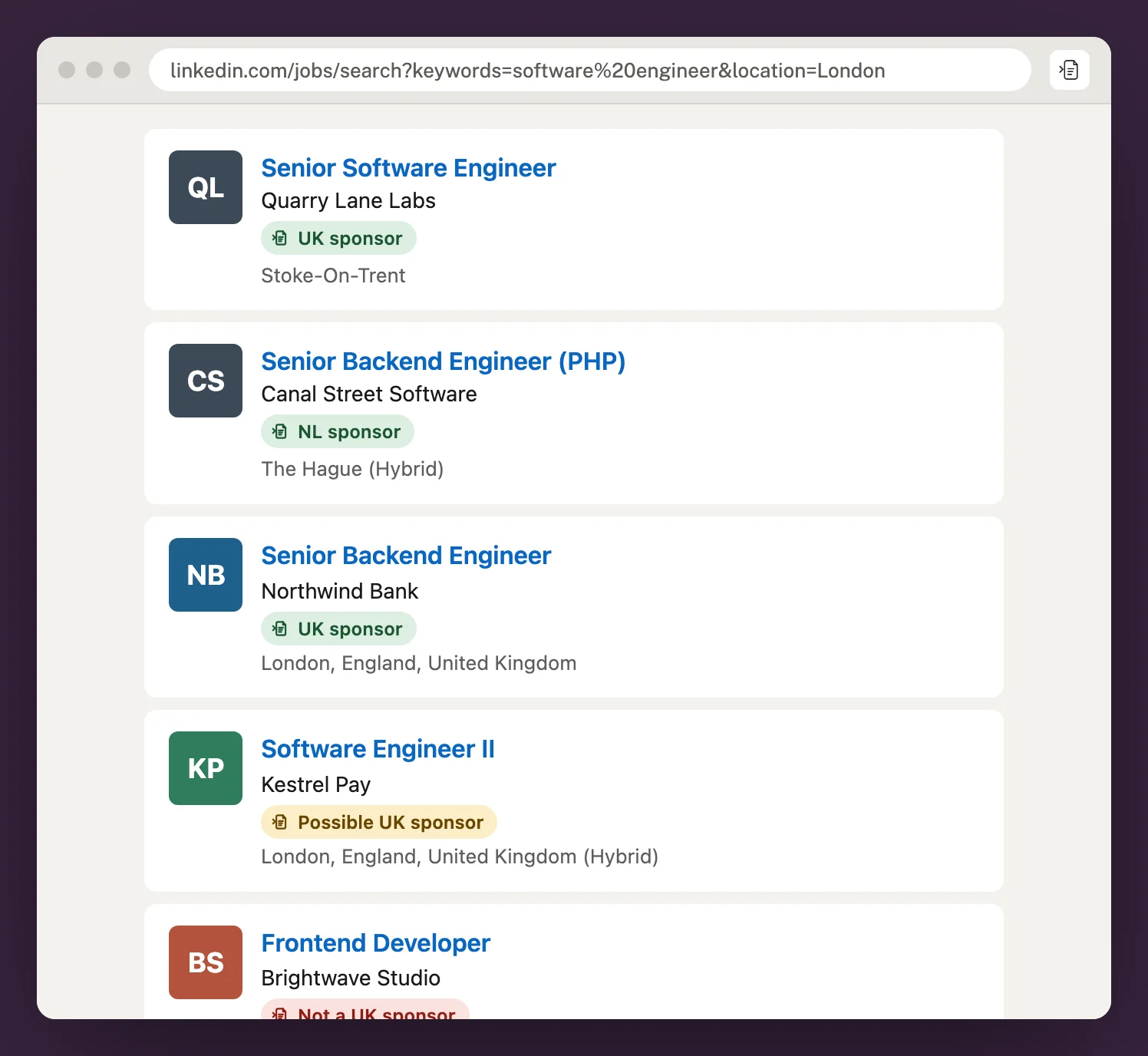
Chrome extension
Check sponsors while you browse LinkedIn.
Sponsor badges appear under every employer in LinkedIn, Indeed and Glassdoor search results, so you can see who can sponsor a visa before you open the job.